
Running a brick manufacturing plant is not only about producing more bricks. The real goal is to increase daily production, reduce waste, control fuel costs, avoid machine breakdowns, and maintain good brick quality.
Many brick plant owners think they need to buy a new machine to increase production. But in many cases, you can improve production significantly by improving your existing process.
A small problem in raw material preparation, drying, machine operation, kiln firing, or material handling can slow down the entire plant.
In this article, we will explain how to increase brick plant production using practical and simple methods that brick manufacturers can understand and implement.
Why Is Your Brick Plant Production Low?
Before increasing production, you first need to understand what is stopping your plant from reaching its full capacity. Common production problems include:
- Frequent machine breakdowns
- Poor-quality raw material mixing
- High moisture in the material
- Slow drying of green bricks
- Cracks and breakage during drying
- Low machine efficiency
- Unplanned kiln downtime
- Uneven brick firing
- High rejection and wastage
- Slow manual material handling
- Lack of trained workers
- Poor production planning
The best way to improve output is to identify the main bottleneck.
For example, there is no benefit in increasing your brick machine speed if your dryer cannot handle the additional bricks. Similarly, producing more green bricks is useless if your kiln capacity is limited.
Find the slowest stage in your production line first and improve that stage.
1. Improve Raw Material Preparation
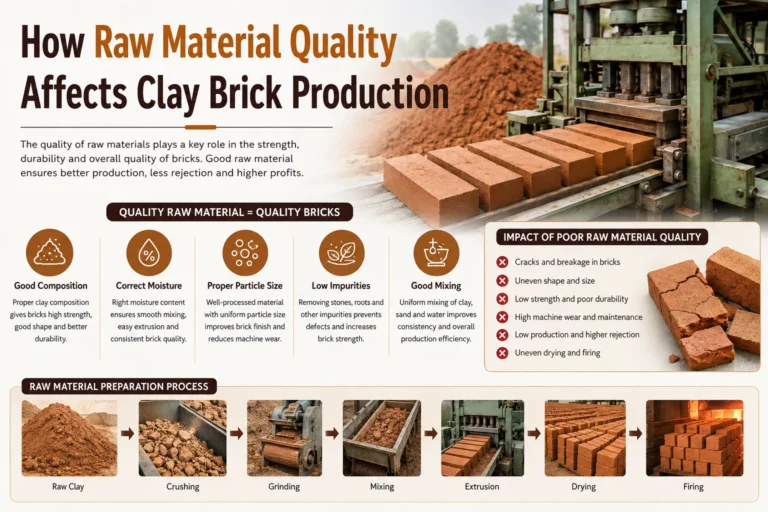
Good brick production starts with good raw material preparation. Whether your plant uses clay, shale, fly ash, or another material, the raw material should be properly prepared before it enters the brick-making machine.
Ensure Proper Crushing and Grinding
Large lumps and uneven particles can create many problems during production. They can cause:
- Poor brick shape
- Surface cracks
- Machine blockage
- Uneven drying
- Higher rejection
Make sure your crushing and grinding equipment produces a uniform material size.
Regularly inspect:
- Crusher rollers
- Screens
- Blades
- Wear parts
- Mixing equipment
Replacing worn parts at the right time can improve both machine performance and brick quality.
Control Moisture Properly
Moisture is one of the most important factors in brick production.
Too much water can cause:
- Sticky material
- Difficult handling
- Longer drying time
- Higher fuel and energy consumption
Too little water can cause:
- Poor molding
- Cracks
- Weak green bricks
- Uneven brick formation
Try to maintain a consistent moisture level based on your raw material and production process.
For larger plants, automatic moisture monitoring can help maintain better consistency.
Give the Material Proper Aging Time
In clay brick production, allowing properly mixed material to rest or age can improve its workability and plasticity.
This can help achieve:
- Better molding
- Fewer cracks
- Improved brick strength
- Lower rejection
The exact aging time depends on the type of clay and your manufacturing process, so test and standardize the best method for your plant.
2. Increase Brick Machine Efficiency
Your brick machine is one of the most important parts of the entire production line.
Even a small improvement in machine efficiency can result in thousands of additional bricks over a month.
Do Not Increase Machine Speed Without Checking the Full Line
Many plant owners simply increase machine speed when they want more production. This can create problems if other sections cannot handle the increased output.
Before increasing speed, check:
- Raw material feeding capacity
- Mixer capacity
- Conveyor speed
- Cutting system
- Dryer capacity
- Kiln capacity
- Worker availability
The entire production line should work in balance.
Check Moulds and Wear Parts
Worn moulds and machine parts can affect:
- Brick size
- Brick shape
- Surface finish
- Production speed
- Rejection rate
Inspect moulds and other critical parts regularly.
Preventive replacement is usually better than waiting for a complete breakdown.
3. Reduce Drying Time Without Increasing Cracks
For many brick plants, drying is one of the biggest production bottlenecks. If green bricks take too long to dry, the machine may produce more bricks than the dryer can process. This creates congestion and reduces the overall production capacity.
The goal is not simply to dry bricks at a higher temperature. The goal is to remove moisture evenly and safely.
Improve Air Circulation
Good airflow is essential for faster and uniform drying.
Make sure:
- Bricks are not stacked too closely
- Air can move between the bricks
- Drying racks are properly arranged
- Fans are working efficiently
- Humid air can leave the drying area
Poor airflow can increase drying time and cause uneven moisture removal.
Control Heat and Humidity
Very fast drying can cause cracks, especially when the surface of the brick dries faster than the inside.
A good drying process requires the correct balance of:
- Temperature
- Airflow
- Humidity
- Drying time
Monitor the drying process and identify where cracks or deformation are happening.
Use Waste Heat Where Possible
In plants with suitable kiln and dryer systems, waste heat from the firing process can sometimes be recovered and used for drying.
This can help:
- Reduce energy costs
- Improve energy efficiency
- Support faster drying
- Increase overall plant productivity
The system should be properly designed according to your plant layout and process requirements.
4. Improve Kiln Efficiency to Increase Overall Production
The kiln is the heart of a brick manufacturing plant.
If the kiln is inefficient, even the fastest brick machine cannot increase your final production.
A kiln with poor temperature control can cause:
- Under-fired bricks
- Over-fired bricks
- Colour variation
- Higher fuel consumption
- More rejected bricks
- Longer production cycles
Load the Kiln Correctly
Kiln loading should allow proper heat circulation.
If bricks are placed too close together, heat may not reach every brick evenly. If there is too much empty space, you may waste kiln capacity and fuel.
Create a standard loading pattern based on your:
- Brick size
- Kiln design
- Fuel
- Airflow
- Firing process
Train workers to follow the same loading method every time.
Check for Air Leaks
Air leaks in kiln doors, walls, or other areas can affect temperature control and fuel efficiency.
Regularly inspect for:
- Cracks
- Damaged doors
- Gaps
- Damaged insulation
- Air leakage points
Small maintenance work can prevent major energy and production losses.
Monitor Temperature Consistently
Do not depend only on visual observation.
A proper temperature monitoring system can help identify firing problems early and maintain more consistent brick quality.
Track your kiln performance regularly, including:
- Firing time
- Temperature pattern
- Fuel consumption
- Rejection percentage
- Final brick quality
5. Reduce Manual Handling and Material Movement Time
In many brick plants, workers spend a lot of time moving materials and bricks from one location to another. This may not look like a major problem, but unnecessary movement can reduce overall productivity.
Study the complete material flow:
Raw Material → Preparation → Brick Machine → Cutting → Drying → Kiln → Sorting → Stacking → Dispatch
Look for unnecessary movement and delays.
Use Proper Conveyor Systems
A well-designed conveyor system can reduce:
- Manual labour
- Material waiting time
- Handling damage
- Worker fatigue
However, conveyor speed should be matched with the capacity of the next process. A very fast conveyor is not useful if it creates a bottleneck further down the production line.
Consider Automation Where It Gives Real Value
Depending on your production volume and budget, automation may be useful for:
- Raw material feeding
- Brick cutting
- Brick setting
- Kiln car loading
- Stacking
- Palletizing
You do not need to automate the entire plant at once. Start with the area where you have the biggest labour shortage, highest damage, or slowest production.
6. Focus on Preventive Maintenance
One unexpected machine breakdown can stop your entire production line. For example, a small bearing failure can stop a major machine if you do not have the spare part available. This is why preventive maintenance is essential for increasing brick plant production.
Create a Simple Maintenance Schedule
Every important machine should have a maintenance checklist.
Include activities such as:
- Lubrication
- Bolt tightening
- Bearing inspection
- Belt checking
- Roller inspection
- Electrical connection checks
- Oil level checks
- Cleaning
Do not wait until the machine stops working.
Keep Critical Spare Parts Available
Identify the parts that can stop production immediately.
Keep important spares available based on your machine design, such as:
- Bearings
- Belts
- Chains
- Sensors
- Electrical components
- Mould wear parts
- Conveyor parts
This can save days of downtime.
Track Machine Downtime
Maintain a simple record showing:
- Which machine stopped
- Why it stopped
- How long it stopped
- What repair was required
After a few months, you will clearly see which machines are causing the biggest production losses.
Then you can focus your maintenance efforts on the real problem.
7. Reduce Brick Rejection and Wastage
Increasing production is not only about making more bricks. If you produce 100,000 bricks but reject 10,000, your actual production is much lower. Reducing rejection is one of the easiest ways to increase effective production without purchasing additional machinery.
Common reasons for brick rejection include:
- Cracks
- Incorrect dimensions
- Broken corners
- Uneven firing
- Under-firing
- Over-firing
- Poor raw material mixing
- Damage during handling
Measure Your Rejection Rate
Track rejected bricks every day or shift. Also record the reason for rejection.
For example:
| Rejection Problem | Possible Area to Check |
|---|---|
| Drying cracks | Moisture, airflow, drying speed |
| Broken corners | Handling and stacking |
| Uneven size | Moulds and cutting system |
| Uneven firing | Kiln temperature and loading |
| Weak bricks | Raw material and process control |
When you know the exact reason for wastage, solving the problem becomes much easier.
8. Train Workers and Create Clear SOPs
Machines are important, but skilled workers are equally important. A good machine can still produce poor results if it is operated incorrectly. Create simple Standard Operating Procedures (SOPs) for every major process.
Use simple language and, where possible, include photos or visual instructions.
Your SOPs can cover:
- Machine startup
- Machine shutdown
- Raw material mixing
- Moisture checking
- Brick quality inspection
- Dryer operation
- Kiln loading
- Maintenance
- Safety procedures
Cross-Train Your Workers
Do not depend on only one person for a critical job. Train backup workers for important positions such as:
- Machine operator
- Kiln operator
- Maintenance technician
- Quality inspector
This helps production continue even when a key worker is absent.
9. Use Production Data to Find the Real Bottleneck
Many brick plants make decisions based on assumptions. Instead, use actual production data. Track important numbers daily.
Important Brick Plant KPIs to Monitor
- Total bricks produced per day
- Good bricks produced
- Rejected bricks
- Machine downtime
- Dryer rejection
- Kiln rejection
- Fuel consumption
- Power consumption
- Production per shift
- Labour productivity
You do not need complicated software in the beginning. Even a properly maintained Excel sheet can help you understand where production is being lost.
Follow This Simple Formula
Find the problem → Measure the loss → Fix the root cause → Measure the improvement
For example, if your plant loses two hours every day because of conveyor breakdowns, improving that one issue may increase production more than buying an expensive new machine.
10. Improve Plant Layout and Production Flow
A poorly designed plant layout can create unnecessary waiting and movement. Look at your plant from the beginning of production to the final dispatch stage.
Ask simple questions:
- Is material moving unnecessarily?
- Are workers walking long distances?
- Are bricks waiting between processes?
- Is one machine regularly waiting for another?
- Is there enough space for safe movement?
- Where does congestion happen?
Improving the production flow can reduce delays without major investment. Apply basic workplace organization methods such as 5S to keep tools, spare parts, and work areas organized.
A clean and organized plant can improve:
- Worker productivity
- Safety
- Maintenance speed
- Material movement
- Problem identification
11. Plan Production According to Real Plant Capacity
Do not set production targets based only on the rated capacity of your brick machine. Your actual production capacity depends on the capacity of the entire system.
For example:
- Brick machine capacity: 20,000 bricks/day
- Dryer capacity: 16,000 bricks/day
- Kiln capacity: 15,000 bricks/day
In this situation, your final production is limited by the 15,000-brick kiln capacity, not the machine’s 20,000-brick capacity. This is why plant owners should calculate the capacity of every major stage. The slowest stage becomes your production bottleneck.
Improve that stage first.
12. Make Small Improvements Every Month
You do not need to make huge changes overnight. The best brick plants improve continuously.
Every month, select one important issue, such as:
- Reducing machine downtime
- Improving dryer airflow
- Reducing fuel consumption
- Lowering rejection
- Improving mould life
- Reducing handling damage
Measure the result before and after the improvement. Over time, many small improvements can create a major increase in production and profit.
Final Thoughts: How to Increase Brick Plant Production Successfully
The best way to increase brick plant production is not simply to run your machines faster. Real production growth comes from improving the complete manufacturing process.
Focus on these key areas:
- Prepare raw materials properly.
- Maintain consistent moisture and material quality.
- Improve brick machine efficiency.
- Reduce drying time without causing cracks.
- Optimize kiln loading and firing.
- Reduce machine breakdowns with preventive maintenance.
- Reduce brick rejection and wastage.
- Improve material handling and plant flow.
- Train workers and use clear SOPs.
- Track production data and fix the biggest bottleneck first.
Start by checking your current plant performance. Find the one area that is limiting your production the most. Fix that problem, measure the improvement, and then move to the next bottleneck.
The most successful brick plants do not only focus on producing more bricks. They focus on producing more good-quality bricks with less downtime, less waste, and better efficiency.
By following these practical steps, brick manufacturers can increase output, improve product quality, control operating costs, and build a more profitable manufacturing business.