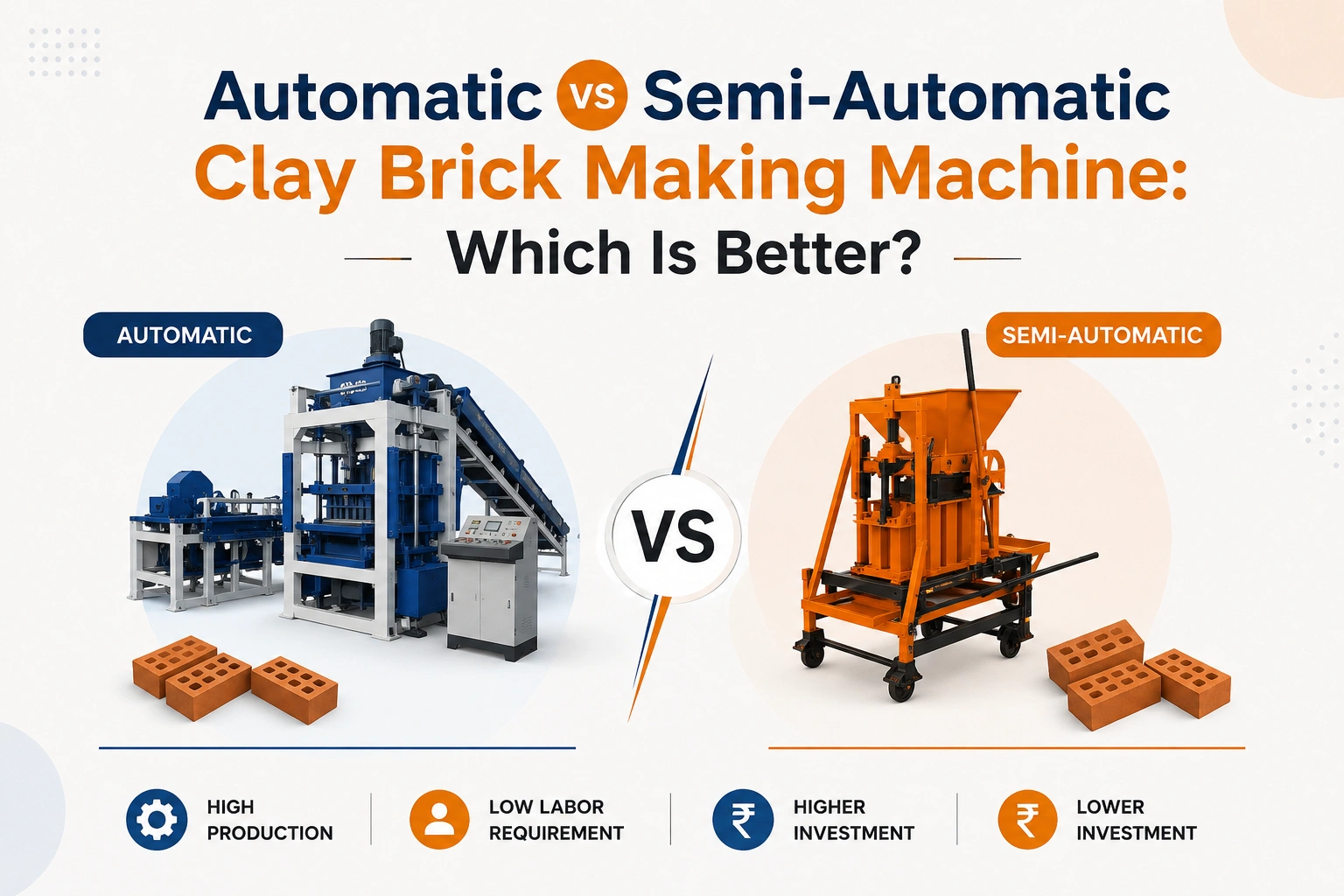

If you want to start a brick making business, one big question comes to mind: Which machine should I buy – automatic or semi-automatic? Many people get confused. This blog will explain everything in very simple English. No hard technical words. Read carefully, and you will understand which machine is right for you.
What is a Clay Brick Making Machine?
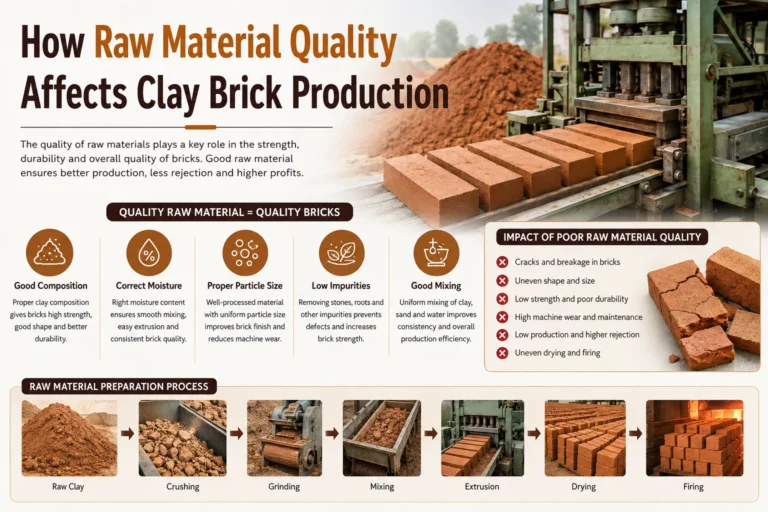
A clay brick making machine takes raw clay (mitti), mixes it with water, presses it into a brick shape, and gives out wet bricks. Then you dry these bricks in the sun or a dryer. After drying, you bake them in a bhatti (kiln) to make strong red bricks.
There are mainly two types of machines:
- Semi-Automatic Machine
- Automatic Machine
Let us understand both one by one.
What is a Semi-Automatic Machine?
Semi means half. Automatic means self-working.
So semi-automatic means half work by machine, half work by people.
In a semi-automatic machine:
- The machine presses the clay into brick shape.
- But a worker has to put clay into the machine by hand.
- Another worker takes out the wet bricks and carries them to the drying area.
- Some workers mix clay and water before feeding.
So the machine does the main pressing work, but you still need 4 to 8 workers to run it properly.
Example:
Think of a washing machine where you put clothes, but you have to take them out and hang them to dry. That is semi-automatic.
What is an Automatic Machine?
Automatic means the machine does almost all work by itself.
In an automatic machine:
- You just pour raw clay into a big funnel (hopper).
- The machine mixes clay and water automatically.
- It presses the bricks.
- It puts the wet bricks on a moving belt.
- Workers only need to stack the bricks and watch the machine.
So you need only 1 to 3 workers to run an automatic machine.
Example:
Think of a fully automatic washing machine that washes and dries clothes. You just put clothes and switch it on. That is automatic.
Main Differences Between Semi-Automatic and Automatic
Here is a simple table to compare both machines:
| Point | Semi-Automatic | Automatic |
|---|---|---|
| Cost (Price) | Low | High |
| Workers Needed | 4 to 8 | 1 to 3 |
| Production Speed | Medium | High |
| Brick Quality | Good, but depends on worker skill | Same size, strong, very uniform |
| Maintenance | Easy and cheap | Complex and costly |
| Power / Electricity Use | Less | More |
| Space Needed | Less | More |
| Best For | Small business, low budget | Big business, high production |
Which Machine is Better? Let Us Compare in Detail
1. Cost (Money Needed)
This is the biggest point for most Indian people.
- Semi-automatic machine costs less. Roughly you can get a good machine in ₹2 lakh to ₹10 lakh, depending on brand and capacity.
- Automatic machine costs much more. It can be ₹10 lakh to ₹50 lakh or even more.
If you have less money, semi-automatic is better. If you have big money and want big business, automatic is better.
Remember: Prices change with brand, capacity, and location. Always check with 2-3 sellers before buying.
2. Labour (Workers Needed)
In India, labour is available in some places, but in many areas, workers are going to cities. Finding good workers is becoming hard.
- Semi-automatic needs 4 to 8 workers. If you have family members who can work, this is okay. You can save labour cost.
- Automatic needs only 1 to 3 workers. If labour is a problem in your area, automatic is better because you do not depend on many workers.
Simple rule:
If you have cheap and reliable workers near your village or town, semi-automatic is fine.
If labour is hard to find or very costly, automatic is better.
3. Production (How Many Bricks in a Day?)
Automatic machines make much more bricks in the same time compared to semi-automatic machines.
- Semi-automatic can make 1,000 to 3,000 bricks per hour (depending on machine size and workers).
- Automatic can make 5,000 to 10,000 bricks per hour or more.
So if you have big orders from builders and contractors, automatic will help you produce more and earn more. But if your market is small, like nearby villages or small towns, semi-automatic production is enough. Making too many bricks without buyers means your money gets stuck.
4. Brick Quality (Same Size and Strength)
Brick quality is very important. Builders want bricks of same size and good strength. If bricks are different sizes, the wall will not be straight and more cement plaster will be needed.
- Automatic machine gives very uniform bricks. The machine controls pressure and mixing, so every brick is almost the same size and strong.
- Semi-automatic machine can also make good bricks, but quality depends on workers. If a worker is tired or careless, brick size may change.
If you want to supply to big builders or government projects, automatic machine is better because they demand high and consistent quality.
If you sell locally, semi-automatic quality is usually accepted.
5. Maintenance and Repair
- Semi-automatic machines are simple. Local mechanics can repair them. Spare parts are cheaper and easily available.
- Automatic machines are complex. They have more electrical and mechanical parts. You may need a trained technician. Spare parts can be costly and may not be available in small towns.
If you live in a remote area with no good mechanic, semi-automatic is safer. If you are near a city and can get service quickly, automatic is okay.
6. Electricity / Power Problem
Both machines need electricity or diesel to run.
- Semi-automatic uses less power. Some parts can be done by hand if power goes off.
- Automatic uses more power. If electricity goes off, the whole machine stops. You may need a diesel generator, which adds fuel cost.
If your area has frequent power cuts, semi-automatic is easier to manage. If you have good power supply or generator, automatic is fine.
7. Space Needed
- Semi-automatic machine needs less space. You can set it up on a small plot.
- Automatic machine needs more space because of the conveyor belt, hopper, and stacking area.
If you have only a small piece of land, semi-automatic is better. If you have big land, automatic can be set up easily.
8. Skill Needed to Run
- Semi-automatic is very easy to learn. Any normal worker can operate it after 1-2 days of training.
- Automatic is also not too hard, but you need some training. The seller usually gives training. Still, a supervisor who understands the machine is helpful.
So, Which Machine is Better for You?
There is no single answer. It depends on your situation.
Choose Semi-Automatic If:
- You have less money (under ₹10 lakh).
- You are starting a small business.
- You have family members or cheap workers.
- Your market is local (nearby villages or town).
- You have small land.
- You want simple maintenance.
- You have frequent power cuts.
Choose Automatic If:
- You have big money (₹15 lakh or more).
- You want to produce a lot of bricks daily.
- Labour is hard to find or very costly.
- You want to supply to big builders or projects.
- You have big land and good power supply.
- You want same size, high quality bricks.
- You already have some experience in brick business.
Smart Advice for New Starters
If you are new to brick business, do not jump directly to automatic. Many successful brick business owners started with a semi-automatic machine. They learned the business, made some profit, and then bought an automatic machine to grow bigger.
Starting small has less risk. If something goes wrong, your loss is small. Once you understand the market, raw material, drying, baking, and selling, then you can upgrade.
Example:
Ramesh from a village in UP started with a semi-automatic machine. He had 5 workers from his own family. He sold bricks to nearby villages. After 2 years, he had good profit and bought an automatic machine. Now he supplies to big builders in the city.
This is a smart way.
Important Tips Before Buying Any Machine
- See the machine working live before buying. Do not buy only by seeing photos or videos.
- Ask about after-sales service. Will the company send a technician if machine breaks?
- Check warranty. What parts are covered and for how long?
- Talk to existing users of the same machine. Ask them about problems.
- Do not buy the cheapest machine. Very cheap machines may break often and waste your money.
- Check power consumption. Ask how many units of electricity it uses per hour.
- Check clay quality in your area. The machine must work well with your local clay. Test with your own clay before buying.
Final Words
Both automatic and semi-automatic clay brick making machines have their own good and bad points.
- Semi-automatic = Low cost, more workers, medium production, simple maintenance. Best for small start.
- Automatic = High cost, less workers, high production, uniform quality. Best for big business.
If you are a small Indian businessman with limited money, semi-automatic is better to start.
If you already have money and want to grow fast without depending on workers, automatic is better. Think about your money, land, labour, power, and market. Then make a wise decision. A brick making business can give good profit if you choose the right machine and work hard.
Good luck with your brick business!