
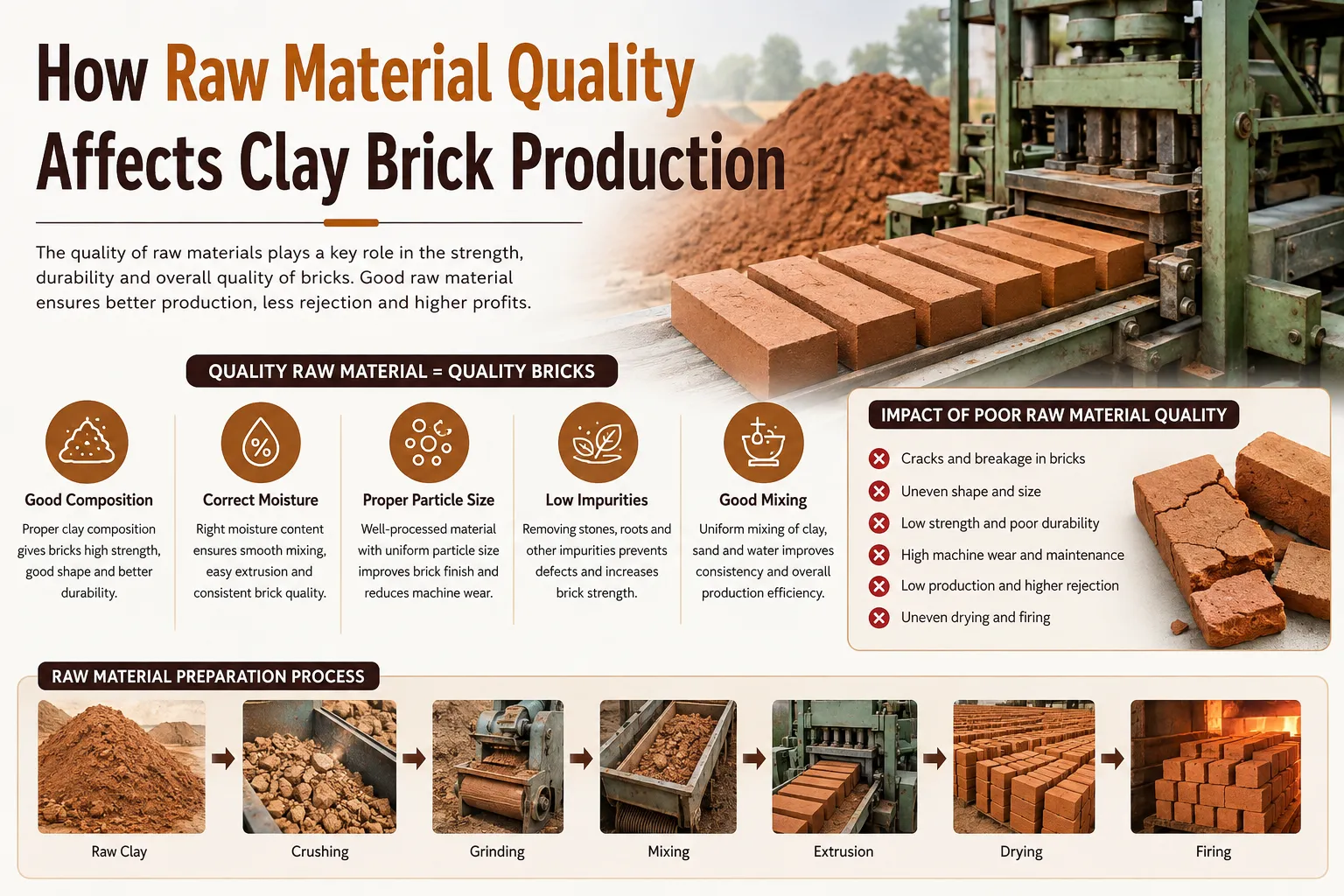

Clay brick production starts with one critical factor: the quality of the raw material. Even the most modern and efficient machinery cannot overcome poorly prepared or inconsistent clay. Raw material quality directly influences brick strength, shape, colour, drying behaviour, and overall product quality. It also affects machine performance, production capacity, maintenance costs, and rejection rates.
In this article, we explain in simple terms how raw material quality impacts every stage of clay brick production and what manufacturers can do to achieve better, more consistent results.
Looking for the Right Clay Brick Making Machine?
Why Raw Material Quality Matters
A clay brick making machine produces good bricks only when the material entering it is properly prepared. The raw material must have suitable composition, moisture content, particle size, and consistency.
Poor-quality or inconsistent material commonly causes:
- Cracks in green or finished bricks
- Uneven size and shape
- Low compressive strength
- Poor surface finish
- Machine blockages
- Higher wear and maintenance
- Uneven drying
- Higher rejection rates
- Reduced production efficiency
Well-prepared raw materials, on the other hand, support smooth, stable production and better final product quality.
Main Raw Materials Used in Clay Brick Manufacturing
The exact mix varies by location and brick type, but the common materials are:
- Clay – The primary material. Good clay needs the right plasticity for easy shaping and extrusion.
- Shale and other natural materials – Often blended with clay; they must be properly processed for consistency.
- Sand – Added in controlled amounts to manage shrinkage and adjust composition.
- Water – Essential for mixing, but the correct quantity is critical.
- Additives – Sometimes used to improve specific properties of the mix or finished bricks.
1. Clay Composition Directly Affects Brick Quality
Not all clay is the same. Composition varies by location and even within the same quarry. It influences plasticity, shrinkage, strength, drying behaviour, firing performance, and final colour.
Clay with good plasticity mixes, shapes, and extrudes easily. Excessive plasticity, however, increases shrinkage and the risk of drying or firing cracks. Frequent uncontrolled changes in composition make the process unstable—machine settings that work for one batch may fail for the next.
Regular testing and controlled blending are essential for stable production.
2. Moisture Content Affects Extrusion and Brick Shape
Moisture is one of the most important variables in clay preparation.
- Too little water makes the material hard, difficult to mix or extrude, and increases stress on machinery.
- Too much water makes the mix too soft, leading to deformed bricks, poor dimensional accuracy, difficult cutting, longer drying times, and higher shrinkage or cracking risk.
The goal is consistent moisture matched to the specific raw material and production method. Proper mixing and moisture control allow the clay to flow smoothly through the equipment and produce uniform shapes.
3. Particle Size Plays an Important Role
Large stones, hard lumps, and oversized particles create serious problems. Material must be properly crushed, ground, and screened before it reaches the extruder.
Correct particle size delivers:
- Better mixing
- Smooth extrusion
- Uniform texture and surface finish
- Lower risk of blockages
- More consistent brick quality
Oversized particles can damage equipment and create weak points in the finished bricks. Thorough preparation is a core part of the manufacturing process.
4. Impurities Reduce Brick Quality and Increase Wear
Raw clay often contains stones, large lime particles, organic matter, roots, debris, or hard lumps. These should be removed as far as possible before the main production line.
Impurities cause cracks, weak areas, surface defects, and accelerated wear on crushers, rollers, and extruder parts. A proper material preparation system protects both product quality and equipment life.
5. Raw Material Quality Affects Machine Performance
Machine performance depends heavily on material consistency. Well-prepared material provides:
- Stable flow
- Smooth extrusion
- Uniform brick dimensions
- Reduced mechanical stress
- Lower component wear
- Less downtime
- Higher overall efficiency
Hard lumps, incorrect moisture, or large impurities increase load, cause blockages, and shorten equipment life. Improving raw material quality therefore improves both brick quality and the longevity of the machinery.
6. Raw Material Quality Affects Brick Strength
Proper selection, crushing, mixing, and moisture control create a more uniform internal structure in the green brick. This leads to higher and more consistent strength after drying and firing.
Poor consistency produces weak zones, cracks, higher breakage, uneven shrinkage, and lower overall strength. Good results in drying and firing are difficult if the starting material is already compromised.
7. Effect on Drying
Green bricks must lose moisture evenly. Inconsistent raw material causes:
- Drying cracks
- Uneven shrinkage
- Warping
- Deformation
When different parts of the brick dry at different rates, internal stresses develop and cracking often follows. Consistent material preparation produces more uniform drying behaviour.
8. Effect on Firing
Raw material composition influences how bricks respond in the kiln—colour, strength, shrinkage, and surface appearance can all vary if the material is inconsistent between batches. Stable raw material quality leads to more predictable and uniform firing results.
How to Improve Raw Material Quality Before Production
Practical steps manufacturers can take:
- Test the raw material regularly – Understand composition, plasticity, and potential problems early.
- Remove impurities – Stones, roots, debris, and large lime particles.
- Crush hard lumps and oversized material – Achieve consistent particle size.
- Maintain consistent moisture – Measure and control water addition carefully.
- Mix thoroughly – Ensure even distribution of moisture and materials.
- Use the right clay preparation equipment – Box feeders, crushers, roller mills, mixers, and other processing equipment matched to the material and capacity.
- Monitor quality continuously – Do not rely on one-time checks; adjust as material varies.
Raw Material Quality and Production Efficiency
| Raw Material Condition | Effect on Brick Production |
|---|---|
| Consistent clay composition | More stable production |
| Proper moisture content | Better mixing and extrusion |
| Uniform particle size | Improved brick consistency |
| Low level of impurities | Less machine wear and fewer blockages |
| Proper material mixing | Better strength and overall quality |
| Poor material consistency | Higher rejection and downtime |
| Excess moisture | Deformation and longer drying time |
| Hard lumps and stones | Equipment wear and production problems |
Better preparation supports both higher product quality and higher production efficiency.
Choosing the Right Equipment for Raw Material Preparation
A complete clay brick plant is more than the final extruder. The preparation line is equally important. When selecting equipment, consider:
- Type of clay and other materials
- Level of impurities
- Required production capacity
- Target particle size
- Moisture requirements
- Desired automation level
- Available plant space
The right preparation system reduces manual work, improves consistency, and allows the main brick-making machine to operate at its best.
Common Problems Caused by Poor Raw Material Quality
- Frequent machine issues and blockages
- Lower production output and more downtime
- Higher rejection rates (cracks, deformation, poor shape)
- Reduced brick strength
- Increased maintenance costs and faster wear
Conclusion
Raw material quality influences every stage of clay brick production—from mixing and extrusion through drying and firing. It affects machine performance, production efficiency, brick strength, dimensional accuracy, and overall product consistency.
Even the best clay brick making machine delivers its full potential only when it receives properly prepared material. Manufacturers who focus on clay selection, impurity removal, particle-size control, thorough mixing, and accurate moisture management achieve lower rejection rates, longer equipment life, smoother operations, and higher-quality bricks.
In simple terms: better raw materials lead to better production, better machine performance, and better bricks.