
The demand for efficient and reliable brick manufacturing equipment continues to grow as construction projects require large volumes of high-quality bricks. A clay brick making machine helps manufacturers produce uniform bricks with better efficiency, reduced manual labor, and more consistent quality.
Whether you are planning to start a new brick manufacturing plant or upgrade an existing production line, choosing the right machine is an important business decision. Machine capacity, automation level, raw material quality, production requirements, and maintenance needs can all affect the final output and profitability of your operation.
In this guide, we explain what a clay brick making machine is, how it works, the different types available, the brick manufacturing process, and the key factors to consider before choosing a machine.
Looking for the Right Clay Brick Making Machine?
What Is a Clay Brick Making Machine?
A clay brick making machine is industrial equipment used to process prepared clay and form it into uniform green bricks before the drying and firing stages. Depending on the production system, a clay brick manufacturing line may include multiple machines for:
- Raw material crushing
- Clay mixing
- Clay feeding
- Extrusion
- Brick cutting
- Material handling
- Drying and firing
The exact configuration depends on the required production capacity and the level of automation. Modern clay brick machines are designed to improve consistency during the brick-forming process. Properly prepared clay is processed through the machine and shaped into a continuous column or required profile. The material is then cut into individual green bricks of the required size.
How Does a Clay Brick Making Machine Work?
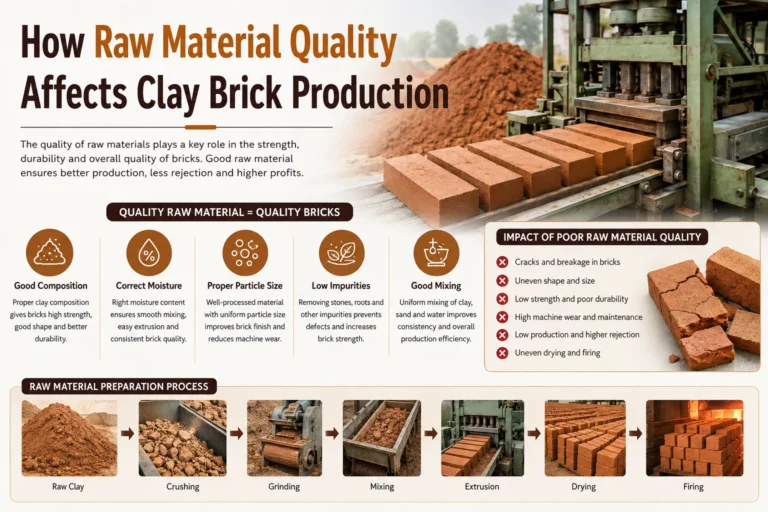
The working process of a clay brick making machine generally begins with raw material preparation. Clay must be properly processed before it reaches the brick-forming equipment.
A typical process includes the following stages:
1. Raw Material Preparation
Clay and other required materials are collected and prepared. Large lumps, stones, and unwanted materials may need to be removed or reduced before further processing. The quality of raw material preparation directly affects machine performance and final brick quality.
2. Crushing and Grinding
Large pieces of clay are broken down into smaller particles. This helps create a more uniform material for the next processing stages. Proper crushing can improve the consistency of the clay mixture and reduce problems during extrusion.
3. Mixing
Water is added to the processed clay according to the required moisture level. The material is mixed thoroughly to create a homogeneous clay body. Poor mixing can result in inconsistent brick density, cracks, or other quality issues.
4. Feeding and Processing
The prepared clay is continuously fed into the brick-making system. Depending on the production line, equipment such as box feeders and mixers may regulate material flow. Consistent feeding is important for maintaining stable production.
5. Extrusion and Brick Forming
The prepared clay passes through an extruder and is compressed before being forced through a die. This produces a continuous clay column with the required shape. The quality of the die and extrusion process plays an important role in maintaining accurate brick dimensions.
6. Brick Cutting
The continuous clay column is cut into individual green bricks using a cutting machine. Automatic cutting systems can help maintain more consistent brick sizes and improve production speed.
7. Drying
The newly formed bricks contain moisture and must be dried before firing. Proper drying is essential because excessive moisture can cause defects or cracking during the firing process.
8. Firing
After drying, the bricks are fired in a suitable kiln. Controlled firing gives the bricks their final strength, hardness, and durability.
Types of Clay Brick Making Machines
Different types of machines are available based on production capacity, labor requirements, and automation level.
Manual Clay Brick Making Machine
Manual machines require significant human involvement during material handling and brick production. They may be suitable for smaller operations with limited production requirements. However, production capacity and consistency can depend heavily on labor and operational practices.
Semi-Automatic Clay Brick Making Machine
A semi-automatic clay brick making machine combines machine-based processing with manual or partially automated operations. This type of system can be suitable for manufacturers looking to increase production while maintaining a balance between investment and automation.
Some material handling, feeding, cutting, or stacking operations may still require human involvement.
Fully Automatic Clay Brick Making Machine
A fully automatic clay brick making machine is designed for higher-capacity and more integrated production.
Automation can help improve:
- Production consistency
- Material flow
- Labor efficiency
- Process control
- Production speed
The level of automation can vary significantly between manufacturers and production-line configurations. Buyers should therefore evaluate the complete process rather than selecting a machine based only on the word “automatic.”
Main Components of a Clay Brick Production Line
A complete clay brick manufacturing plant may include several pieces of equipment working together.
Box Feeder
A box feeder helps supply raw material at a controlled and consistent rate to the next stage of the production line. Stable material feeding is important for continuous plant operation.
Roller Crusher
A roller crusher helps reduce clay particles and improve material consistency before further processing. The required crushing arrangement depends on the characteristics of the raw material.
Clay Mixer
A clay mixer combines the material and water to achieve a more uniform clay mixture. Proper mixing is essential for producing consistent bricks.
Vacuum Extruder
The vacuum extruder is one of the most important machines in a clay brick production line. It processes and compresses the prepared clay before forcing it through a die. Vacuum processing can help reduce air within the clay body and improve the density and quality of the formed product.
Brick Cutting Machine
The cutting machine divides the continuous clay column into individual green bricks according to the required dimensions. Accurate cutting helps maintain uniformity and reduces dimensional variation.
Material Handling Equipment
Conveyors and other material-handling systems connect different stages of the production process. Efficient material movement can reduce manual handling and production bottlenecks.
Clay Brick Manufacturing Process Step by Step
Understanding the complete production process is important when selecting a clay brick making machine. The general manufacturing sequence is:
Raw Clay → Crushing → Mixing → Feeding → Extrusion → Cutting → Drying → Firing → Finished Bricks
Every stage affects the next one.
For example, even an advanced brick-making machine may not deliver the expected results if the raw material is poorly prepared. Similarly, efficient extrusion cannot compensate for major problems in drying or firing. For this reason, successful brick manufacturing requires a properly designed production system rather than focusing only on one machine.
Benefits of Using a Modern Clay Brick Making Machine
Improved Production Efficiency
Modern machinery can process larger volumes of material compared with highly manual production methods. The actual output depends on machine capacity, raw material characteristics, operational efficiency, and the overall plant setup.
Better Brick Consistency
Controlled extrusion and cutting can help manufacturers produce bricks with more uniform dimensions. Consistency is important for product quality and customer satisfaction.
Reduced Dependence on Manual Labor
Automation can reduce the amount of manual work required for repetitive production activities. This can help manufacturers improve operational efficiency, particularly in larger production facilities.
Continuous Production Capability
Well-designed production lines can support continuous material flow between different stages. Reducing unnecessary stoppages can increase overall plant productivity.
Better Process Control
Modern systems may provide improved control over feeding, mixing, extrusion, and cutting. However, operators still need to monitor machine performance and maintain proper process settings.
Read our guide on how to increase brick plant production.
How to Choose the Right Clay Brick Making Machine
Selecting the right machine requires more than comparing prices. Consider the following factors before making a purchase.
1. Required Production Capacity
Start by calculating your target production requirement.
Ask questions such as:
- How many bricks do you need to produce per day?
- How many operating hours will the plant run?
- Do you expect production to increase in the future?
- What capacity is required during peak demand?
Choose equipment based on realistic production requirements rather than simply selecting the largest available machine.
2. Raw Material Characteristics
Different clay sources can have different properties. Before selecting a machine, evaluate:
- Clay composition
- Moisture requirements
- Particle size
- Presence of stones or hard materials
- Required additives
Machine configuration should match the available raw material.
3. Automation Requirements
Consider whether a manual, semi-automatic, or fully automatic system is most suitable for your business. Higher automation can improve efficiency, but it may also require a larger initial investment and more sophisticated operational systems. The best choice depends on your production goals and business requirements.
4. Machine Quality and Construction
Industrial brick machinery operates under demanding conditions.
Check important factors such as:
- Machine structure
- Wear-resistant components
- Drive system quality
- Ease of maintenance
- Availability of spare parts
A low initial price may not always result in the lowest long-term operating cost.
5. Power and Energy Requirements
Evaluate the power consumption of the complete production line. Consider both the main machine and supporting equipment such as crushers, mixers, conveyors, cutters, and handling systems. Energy efficiency should be considered when calculating long-term operating costs.
6. Manufacturer Support
Technical support is an important factor when investing in industrial machinery. Choose a manufacturer that can provide appropriate assistance with:
- Machine installation
- Operator guidance
- Maintenance support
- Spare parts
- Technical troubleshooting
Reliable after-sales support can help reduce production downtime.
Factors Affecting Clay Brick Making Machine Price
There is no single price for every clay brick making machine because the final cost depends on the machine configuration. Major factors include:
Production Capacity
Higher-capacity machines generally require larger and more powerful components.
Level of Automation
Additional automation systems can increase the initial investment.
Machine Configuration
The total price can vary depending on whether the buyer requires only a single machine or a complete production line.
Raw Material Processing Equipment
Crushers, mixers, feeders, and other preparation equipment can affect the total project cost.
Customization
Special brick sizes, dies, production requirements, and automation features may require customized equipment.
Installation and Support Requirements
Transportation, installation, commissioning, and training requirements should also be considered when evaluating the total investment. Instead of comparing only the purchase price, buyers should evaluate the overall value of the equipment over its operating life.
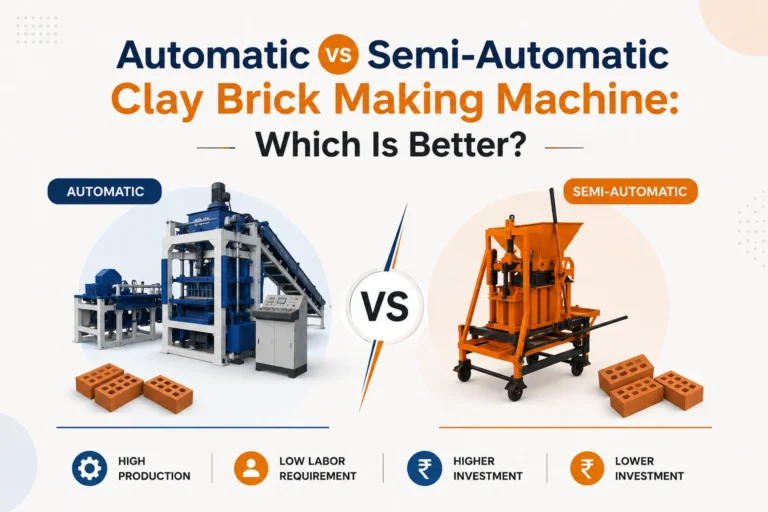
Automatic vs Semi-Automatic Clay Brick Making Machine
Both automatic and semi-automatic systems can be effective. The right choice depends on the production requirement.
Semi-Automatic System
A semi-automatic system may be suitable when:
- Production requirements are moderate
- Manual labor is available
- Initial investment needs to be controlled
- Some manual operations are acceptable
Fully Automatic System
A fully automatic system may be more suitable when:
- High production capacity is required
- Consistent production is a priority
- The manufacturer wants to reduce repetitive manual work
- A more integrated production process is required
The decision should be based on a complete cost and production analysis.
Learn more about automatic vs semi-automatic clay brick making machines.
How to Improve Clay Brick Machine Performance
Buying a good machine is only one part of successful production. Manufacturers should also focus on operational practices.
Maintain Consistent Raw Material Quality
Variations in clay quality can affect machine performance and brick quality. Monitor incoming material and maintain a consistent preparation process.
Follow Preventive Maintenance
Regular inspection and maintenance can help identify wear before it causes major production problems.
Important areas may include:
- Bearings
- Drives
- Belts
- Wear parts
- Lubrication points
- Cutting components
Train Machine Operators
Proper machine operation is essential for both productivity and safety. Operators should understand machine settings, normal operating conditions, and basic troubleshooting procedures.
Monitor Production Data
Track key information such as:
- Daily production
- Machine downtime
- Rejection rates
- Maintenance frequency
- Energy consumption
Production data can help management identify bottlenecks and opportunities for improvement.
Common Problems That Can Affect Brick Production
Several factors can reduce the performance of a clay brick manufacturing operation.
Poor Clay Preparation
Large particles and inconsistent material can create processing problems and affect product quality.
Incorrect Moisture Content
Too much or too little moisture can affect mixing, extrusion, and the quality of the green bricks.
Uneven Material Feeding
Irregular feeding can result in unstable machine performance.
Worn Machine Components
Worn dies, cutting wires, rollers, and other components can affect production quality and consistency.
Lack of Preventive Maintenance
Unexpected machine failures can cause costly production downtime.
A structured maintenance program can help reduce avoidable interruptions.
Why the Complete Production Line Matters
When searching for a clay brick making machine, many buyers focus only on the main brick-forming machine.
However, overall production performance depends on the complete system.
A high-capacity extruder may not achieve its expected output if:
- The feeder cannot supply enough material
- The crushing system creates a bottleneck
- The clay mixer cannot maintain consistent preparation
- Material handling is inefficient
- The cutting system cannot match production speed
- Drying capacity is insufficient
For this reason, production-line planning should consider every stage from raw material preparation to finished brick handling.
Frequently Asked Questions About Clay Brick Making Machines
What is a clay brick making machine?
A clay brick making machine is industrial equipment used to process prepared clay and form it into uniform green bricks before drying and firing.
Which type of clay brick making machine is best?
The best machine depends on your production capacity, raw material, automation requirements, budget, and available infrastructure. A machine suitable for a small plant may not be suitable for a large continuous production line.
How does an automatic clay brick making machine work?
An automatic system uses integrated equipment and controls to reduce manual involvement in selected production stages. The exact automation level depends on the design of the production line.
What affects the price of a Clay Brick making Machine?
Price can depend on capacity, automation level, machine configuration, materials, technical specifications, customization, and whether the purchase includes a complete production line.
How can I increase Brick Plant Production?
Improving raw material preparation, reducing machine downtime, maintaining consistent feeding, training operators, and improving preventive maintenance can help increase production efficiency.
Conclusion
A clay brick making machine is an important investment for any modern brick manufacturing operation. However, selecting the right equipment requires careful consideration of production capacity, raw material characteristics, automation needs, operating costs, and long-term maintenance.
The most effective solution is not necessarily the machine with the highest capacity or the lowest purchase price. The right choice is a production system that matches your specific manufacturing requirements and provides reliable, consistent performance.
Before investing, evaluate the complete brick manufacturing process—from raw material preparation and mixing to extrusion, cutting, drying, and firing. A well-planned production line can help improve efficiency, maintain brick quality, reduce unnecessary downtime, and support long-term business growth.